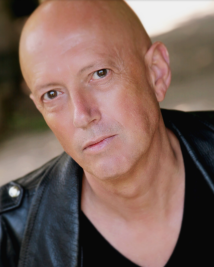
Martin Lewton has been making theatre all of his life, and queer theatre for the last twenty years with his company, Theatre North. He also teaches acting, devising and text at the Institute of the Arts Barcelona. Here, as his new book Out On Stage: How to Make Queer Theatre is published, he shares his essential advice on making queer theatre today, and how to overcome the inevitable challenges facing any queer theatre maker…
I lived in Yorkshire for many years, where they say, ‘There’s nowt so queer as folk’, meaning there’s no rhyme or reason to the way people behave. Or, looking at it from a different angle: when people act in unconventional ways, it’s hard to understand them. We often judge people by standards we assume are universal, and we’re troubled or confused when we encounter someone or something that breaks the mould.
Queer breaks the mould. Queer people – and the things we do and say, the art we create, the theatre we make – have been judged by that yardstick for centuries. Queer people have a different perspective on the world, and a different place within it. We have been, for better or worse, shaped by our experiences of oppression, of having to lead double lives. Most of us have grown up in the straight world, and it has taken an effort of will and self-determination to see ourselves as something other than straight, and to live our lives accordingly.
There are, of course, many different types of queer people, and queer culture is far from monolithic; but what we have in common is that we belong in a minority, with an identity that we’ve had to define for ourselves, very often in opposition to the way that we’ve been seen by others. Queer culture and identity is, in the broadest sense, oppositional.
It’s no surprise then that queer theatre is often oppositional too. From its very beginnings – which are the beginnings of theatre itself, in the theatre of the Ancient Greeks – it has torn up conventions, presented things differently, done things that audiences will find shocking or unacceptable. Sometimes the shock is intentional, a way of jolting the audience out of its habitual ways of thinking. Sometimes it’s not the theatre maker’s primary intention, but just an inevitable by-product of presenting something that’s unconventional and new. There’s nowt so queer as folk. Anything different is likely to shock. As makers of queer theatre, what we are doing is saying to the world: ‘We’re here and we’re queer!’
In my book, Out On Stage: How to Make Queer Theatre, I look at what we mean by queer theatre, the many different forms it can take, and how it can be made. It’s a practical book, full of hands-on tips and advice, not just from me but in the words of a whole host of top theatre makers: writers such as Jonathan Harvey, Iman Qureshi, Neil Bartlett and Nathaniel J Hall; live artists such as Travis Alabanza, Ursula Martinez and Krishna Ishtha; producers such as Dais Hale, Brian Merriman of Dublin Gay Theatre Festival, Tarik Elmoutawakil and David Sheppeard of Brownton Abbey, and many more. It’s a book of queer ideas, queer questions and queer inspiration, and I hope it will be useful to anyone embarking on, or already enjoying, a career in queer theatre.
One of the key sections in the book looks at how you can deal with the inevitable challenges you will face as a queer theatre maker. Unfortunately, we live in a world where queer rights – many of them won at great cost over the last few decades – are now being challenged or eroded in many parts of the world. In the long run, I do believe that these reactionary forces are destined to fail. Truths about gender and sexuality are out of the bottle and cannot be put back in. They might be violently or culturally suppressed, but they can no longer be made to disappear. We can take heart from that. Still, there’s much to be done, and I hope that my book illuminates some of the paths that can be taken. Queers must take the lead in a proper discussion of gender and sexuality – and queer theatre will be at the forefront of this work. We are the future. And we must come together to shape it.
Overcoming challenges
Radical, experimental, oppositional theatre has always found itself under attack. It’s in the nature of the work. If you’re making theatre that opposes the patriarchal, heterosexual status quo and you don’t meet opposition, you’re probably doing it wrong.
So how do you deal with opposition when it comes your way?
Firstly, accept that it will happen. Your work will be commented on, favourably and (most likely) unfavourably, and that’s part of life as a creative artist. You will need to grow a thick skin. At the same time, try to distinguish between the different kinds of opposition you might encounter: is it valid criticism, shameless pandering to vested interests, or downright trolling? Let’s take each of these in turn…
Valid criticism, especially if it comes from an influential source with the power to make or break a show (an established theatre critic, for instance, or an artistic director you were hoping would programme your show), can be extremely painful. It can leave you feeling angry or even despairing. You probably won’t be in any mood to listen to it when it comes. But in the long run, taking it on board can make you stronger, and it can improve your work. Learn to recognise when criticism is well-intentioned and constructive. Not all well-intentioned criticism will be helpful, and much of it will be wide of the mark. But often, if someone has taken the time to engage with your work and has taken issue with it, there is a germ of truth in there, and listening to it can help you make better work, now and in the future.
Shameless pandering, on the other hand, happens when critics, commentators or common-or-garden show-offs are more interested in playing to their own constituency than in responding to your work. Remember that all theatre critics – even knowledgeable ones – are writing primarily for their readers (or their proprietors) and are not in the business of furthering your career. A savage review can help sell newspapers (or, more likely these days, serve as click-bait). And that’s not necessarily a bad thing either. Sarah Kane’s debut play Blasted (first staged in 1995) was famously described by the Daily Mail as ‘a disgusting feast of filth’, and it did wonders for the play’s performance at the box office. My own play Lord Arthur’s Bed, which was premiered in the Friends’ Meeting House in Brighton in 2008, was denounced in the Brighton Argus as a ‘Sex Play in Church’. It didn’t matter in the slightest that it was neither a sex play nor being staged in a church – it was simply a wonderful calling card to have, and we sold out!
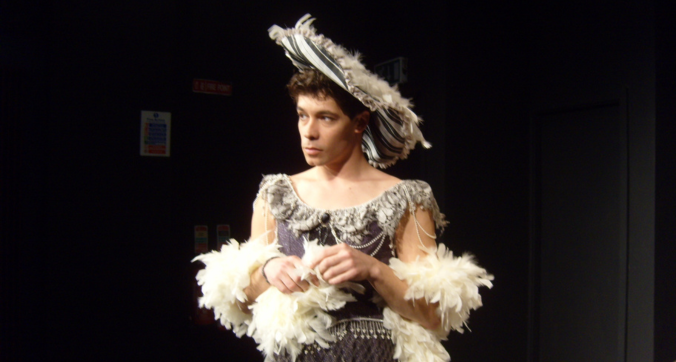
Spencer Charles Noll in Lord Arthur’s Bed, directed by Martin Lewton, 2010
Trolling, if you are unlucky enough to be on the receiving end of it, is pure spitefulness and should be treated with contempt. Generally, it’s best to ignore it if you can, unless of course it constitutes a hate crime – in which case it should be reported immediately to the relevant authorities. Don’t make the mistake of engaging with trolls directly, as you’ll only be fanning their flames. If trolling is persistent and aggravating, there may be other avenues open to you, such as notifying the owner of whatever platform they are using, blocking their messages, or seeking advice from a knowledgeable source (if you belong to a trade union, then you should certainly make use of their advisory services).
More difficult is dealing with venues who won’t consider your show because of the content, or who, having taken it on, try to get you to change it. Often, they will appeal to you to ‘tone it down’, possibly without even realising that what they are doing amounts to censorship. A theatre manager in a major receiving house recently wrote me a charming message about my latest play The Luxurious Time, which is about a gay couple facing dementia, lamenting the fact that, in his opinion, there wasn’t an audience for queer work! This quite simply flies in the face of the facts: queer work is finding plentiful audiences, and not just in London or Brighton. Fortunately, we were able to find alternative venues for the play – including the Omnibus Theatre in Clapham, where it opened last week as part of their 96 Festival of queer theatre.
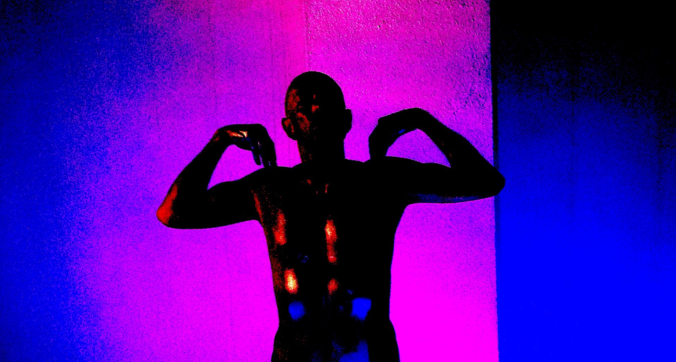
Martin Lewton in Mirando the Gay Tempest, directed by Andrew McKinnon, 2015
You may also meet opposition to your work from funding bodies, local authorities or other institutions that wield power of some form. Arts Council England issued some mutterings a few years ago about reducing support for ‘political’ work. This of course begs the question, what is ‘political’? If it’s work that raises questions about the assumptions and institutions that underpin our lives, then it has to be accepted that any self-identifying queer show must be political to its core. Does this mean that the Arts Council is no longer inclined to support queer work? Let’s hope not. Still, it was a warning sign that difficult times lie ahead. In a culture based on identity politics and fearful of giving offence, it can be hard to find support for work that takes risks. Combine this with a cost-of-living crisis and the long-term trend of reduced funding for the arts, and it’s no wonder that theatres are in many cases playing it safe, rolling out the same unexceptional work that they delivered to audiences in previous seasons.
Sometimes you have to fight back, as I did when I encountered an objection from one local council who ran a venue in which my play Lord Arthur’s Bed was due to be performed. The poster we’d designed for the play featured a tasteful rear view of a naked young man, and the council kept pushing for less and less of him to be visible, until there was nothing left but the man’s head and shoulders. I pointed out to them that this was absurd, and that their objection was clearly related to the content of the play, which was openly queer. They eventually relented, but only because their fear of being accused of homophobia was even greater than their fear of being castigated for endangering public morality with a spot of inoffensive nudity.
On another occasion, my play Naked Homo received an obviously homophobic review on a major website. The male reviewer described feeling threatened when he found himself surrounded by gay men in a gay bar! I hesitated before responding, knowing that it’s generally unwise to complain about reviews, for all the reasons I’ve given above. In the end, I decided to let it go – but now I wish I had responded, at least to point out the implicit homophobia that was colouring his review, and that had nothing at all to do with the content of the play (but possibly everything to do with his judgement of it).
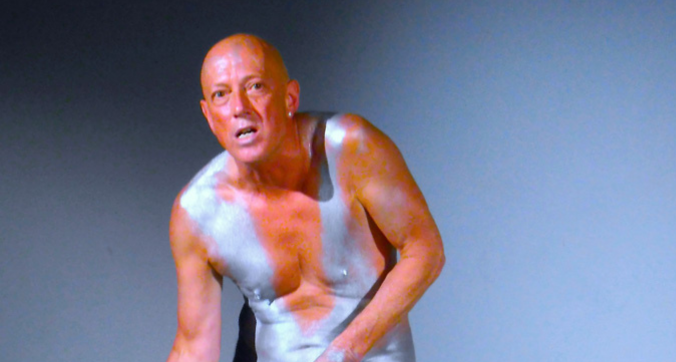
Martin Lewton in Mirando the Gay Tempest, directed by Andrew McKinnon, 2015
Beware too of those who try to censor your work indirectly. I was once approached by the director of a venue where I was about to perform my solo show Cock, which involved me sitting naked in a bath. Having lavished praise on the wonderful script, they asked me to ensure that I kept my body well hidden beneath the bubbles. This, they said, was because the words were so good that the audience wouldn’t want any naked distractions. I was somewhat flattered, and because of that (and also because I wanted to go on working at the venue), I partly complied with the request. But the presence of the performer’s naked body is an important component of that show, and now in retrospect I wish I’d stood firm (metaphorically speaking).
You will undoubtedly experience rejection from venues or funding bodies at some point in your career. Try not to get disheartened by this. Theatre is a competitive business, even before you throw in the additional complexity of being a queer theatre maker. But if you have something to say, if you work hard at your craft, and above all if you stick at it, you are likely to find success.
What pulls queer theatre makers together is the strong belief that the work they’re making is a catalyst for change. Indeed, that is very often the primary reason for making it. Having spoken to a lot of queer theatre makers in the course of writing my book, it’s clear to me that there’s a strong sense that our work represents a coming together in defence of the queer community, and in particular of the trans community, which has been so badly attacked in recent years.
Alongside that sense of community is an openness and a generosity. Queer theatre makers are almost always happy to share their experiences with newcomers and aspiring theatre makers. The advice they give is best summed up in the words: get out there and make the work that you were born to make!
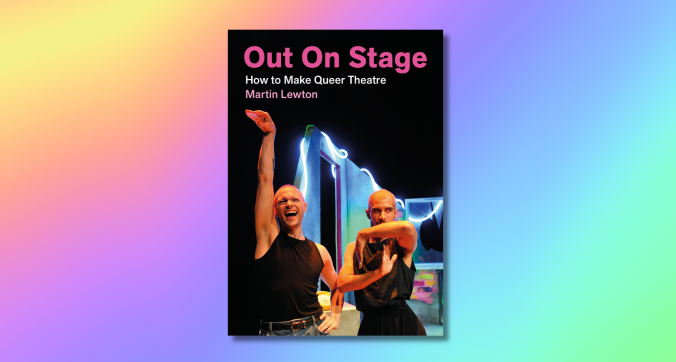
This is an edited extract from Out On Stage by Martin Lewton – out now, published by Nick Hern Books. Save 20% when you buy your copy direct from the publisher here.
Martin Lewton is an actor, director and writer with more than forty plays professionally staged. He is Artistic Director of Theatre North and teaches acting and writing at the Institute of the Arts Barcelona. His plays and performance pieces include Lord Arthur’s Bed, Billy Budd Sailor, Scream Queer Murder and The Luxurious Time – a queer love story.
 The Prompt Book