
If you’re thinking of applying to drama school, then selecting your audition speeches is a key part of the process. But with so many options to choose from, where do you start? And how do you make sure you’re picking speeches that will maximise your chances of success?
Here, John Abbott – a former teacher at leading drama institutions including Mountview and ArtsEd, and author of The Drama School Handbook – shares some advice on how to pick speeches that will help you stand out from the competition…
If your ambition is to become a professional actor, then getting some training at a recognised drama school is a great place to start.
- You’ll meet other people your own age who want to be actors.
- You’ll learn loads of techniques from experts.
- You’ll be in lots of plays.
- And you’ll get an introduction to the world of professional acting.
So, the benefits of going to drama school are clear. But first, you have to get in to one…
Each drama school has its own audition process, with its own particular requirements. But whichever school you apply to, the standby reliable requirements are that they’ll ask you to do two speeches:
- A classical speech – some ask specifically for a speech from a Shakespeare play
- And a contemporary speech – which some drama schools call a modern speech
Most drama schools ask to see a self-tape to start with. And if they like what they see and think their training would be suitable for you, they may give you an audition date to come in and meet them in person. Exciting!
However, this means that choosing the right audition speeches for you – ones that will enable you to showcase your acting skills in the best and most effective way – is crucial to getting your foot in the door.
Here are a few tips on how to choose speeches that will help your talent shine and boost your chances of success.
1. Don’t be afraid of popular speeches
The safe bet for a classical speech is to do one from a Shakespeare play.
Let me lay my cards on the table: if you choose a speech from a Shakespeare play, it is impossible to find one that no one else will be doing.
People holding auditions often hear the same Shakespeare speeches, because they are the ones that are good for young actors.
But the popularity of these speeches never clouds the panel’s judgement of the acting talent on display – so originality in the choice of a classical speech is not a major requirement. Don’t get hung up on it.
2. And don’t be afraid of what’s worked before!
When it comes to choosing your contemporary speech, have a think: have you used a speech in a play at college or in a drama group that you liked and went down well?
If that’s the case, then it would be a good idea to do it for your audition speech.
For a start, you will already have done a lot of work on it. And secondly, you will know the play it came from backwards.
People are sometimes so obsessed with finding something ‘new’ that they dismiss their past successes.
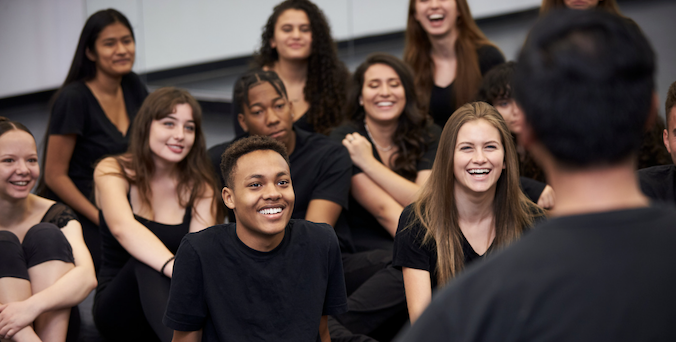
If you’ve previously used a speech that went down well, consider using that for your drama school audition.
3. Focus on acting, rather than trying to shock
Here’s an important piece of advice: don’t try to shock the audition panel by your choice of outrageous material!
For a start, an audition panel is unshockable. In my more than ten years auditioning applicants, I’ve seen it all – and no amount of swearing or sexual content made me feel that the actor was amazingly brave. Or even interesting.
Don’t try to show how shocking you can be. People just want to see if you can act!
4. Pick speeches you personally relate to
Similarly, the type of character you play doesn’t need to be extreme to be effective. In fact, it’s quite a good idea to use speeches in which the characters have the same sort of emotions that you have experienced yourself.
- Most people know what it’s like to fall in love, so either Romeo or Juliet would probably be characters you could choose.
- Maybe you sometimes get angry, so a speech where your character loses their temper would be useful.
- Perhaps you find it easy to make people laugh, so try a funny speech.
- Or if you like explaining things, choose a speech in which your character tells someone about something.
As well as personality, make sure you choose a speech that’s suitable for your age.
Don’t go for King Lear. He’s ancient. I suggest that you choose a character who is no more than fifteen years older than yourself.
5. Contrasting choices can work well
Once you have selected one of your speeches, make sure the other has a different mood or emotion.
- A strong, confident character for your classical, for instance.
- And an uncertain, romantic character for the contemporary.
I bet you’ve experienced both these moods at one time or another.
- Maybe a loud, bombastic speech for one.
- And a quiet, intense speech for the other.
The contrasting moods in the speeches should both be moods and emotions you experience yourself.
Sometimes you are happy, sometimes you are sad. Sometimes you feel full of energy, sometimes you feel knackered. These are the sorts of contrasts to look for.

If one of your characters is happy, then think about choosing a contrasting mood for the other.
6. Keep your speeches short
It may be frightening to hear, but the audition panel usually make up their mind within thirty seconds of you starting your speech.
They may have decided to reject you after thirty seconds, in which case you might as well get it over with as quickly as possible.
Or:
They may recognise your talent immediately! And a long speech could possibly make them change their mind!
Unless the drama school says differently, your audition speeches should last just over a minute and a half each. And definitely no longer than two minutes. That’s all the time you need.
Remember: the worst thing you can do is to bore the audition panel.
7. Never just think ‘that’ll do’
When you’re preparing for a drama school audition, it’s no good thinking ‘that will do’, about any step on the path.
Nothing will ever just ‘do’. It can always be improved.
- If you feel confident with your speech, make sure that you can still do it when you’re nervous.
- If you are in a bad mood on the day of the audition, you must be positive when you do your speeches.
- If you are tired you still need to be able to perform an upbeat, lively speech.
It’s no good coming out of an audition and blaming yourself for not being in the right mood. You have to make sure that you are always in the right mood. You have to be at your best whatever the circumstances.
So, what’s next?
There are about twenty major drama schools in the UK, and each takes roughly thirty new students each year. That’s just six hundred people training to become actors annually.
This means the competition to land a place at drama school is fierce, and in order to succeed you have to be willing to put in the work.
Fortunately, my book The Drama School Handbook is full of advice on everything you need to know to come out on top – including how to make sure you’re applying to the right schools for you, preparing your speeches and understanding how to wow the audition panel, and what to expect on the audition day itself. It also gives you an insight into what your time as a student will be like, as well as guidance on navigating your transition as a new graduate in the professional industry.
If you’re ready to take your first step to achieving your ambition of becoming a professional actor, then pick up a copy – and let’s get to it.
‘Without John Abbott’s exceptional advice and guidance, I would never have made it into the career I so wanted. His words come back to me time and time again – trust me, you need him too!’
Leo Woodall (One Day, The White Lotus), from his Foreword to The Drama School Handbook

This is an edited extract from The Drama School Handbook: Getting In, Getting On and Getting Out There by John Abbott – out now, published by Nick Hern Books. Save 20% when you buy your copy direct from the publisher here.
John Abbott is an author with a wealth of experience in theatre and education. As an actor, he appeared in over eighty stage productions, as well as roles in television series and films such as Four Weddings and a Funeral, Doctor Who, Poirot and The Vicar of Dibley. He has taught acting at numerous institutions including renowned drama schools Mountview and ArtsEd, serving at the latter as Head of Acting.

