 Last month, for the very first time, students sitting their exams in GCSE English Literature had the opportunity to answer questions on Winsome Pinnock’s landmark play Leave Taking.
The addition of Leave Taking marks an important step forward for the GCSE English Literature specification. This powerful, moving play, about a British-Caribbean family in 1980s London, premiered at Liverpool Playhouse Studio in 1987. It was later produced at the National Theatre, London, in 1995 – making Pinnock the first Black woman to have a play staged at the venue. More recently, it received a major revival at the Bush Theatre, London, in 2018, which was made all the more resonant by the unfolding revelations of the Windrush scandal.
To mark Leave Taking’s arrival as a GCSE set text, we’re sharing an interview with its writer, Winsome Pinnock, and first-hand testimony from Samantha Wharton, an experienced teacher who has also written a guide for those studying the play – about why the play’s addition to the curriculum matters, and why teachers and schools should consider adopting it for GCSE.
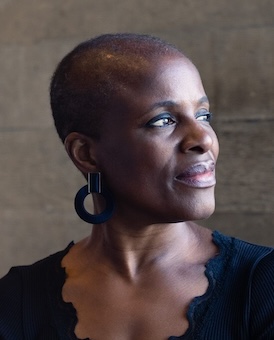 Leave Taking playwright Winsome Pinnock has been described as ‘the godmother of Black British playwrights’, and has been recognised with numerous accolades including the George Devine Award, Alfred Fagon Award, Windham-Campbell Prize for Drama, and a Fellowship of the Royal Society of Literature.
In this edited interview, conducted by the exam board AQA and available to watch in full lower down this page, Winsome reflects on why she wrote Leave Taking, and how she feels about the play’s inclusion in the GCSE English Literature curriculum.
What inspired you to write Leave Taking?
All the plays I’ve written start with observation. Like a lot of writers, I’m always listening to people and watching them, picking things up. Often there will be a theme that comes up time and time again – and that may become the starting point of a play for me.
In the case of Leave Taking, people were talking a lot at the time [in the 1980s] about the generational conflict between first-generation Caribbean immigrants and their children (of which I’m one). There was a conflict between those who migrated from the Caribbean and their British-born children, who felt caught between worlds, really – they didn’t feel that they were part of the Caribbean, but didn’t quite feel that they were being made welcome in Britain, that they weren’t being accepted as British people. That was my starting point.
How do you feel about Leave Taking being adopted as a set text for GCSE English Literature?
I’m so happy Leave Taking has been included. When I was a young person studying English Literature at school – it was my favourite subject – I would never have dreamed that a play that I had written would be included in the curriculum!
My parents were part of the Windrush generation. They’re no longer here, but I feel that some element of their story is being told. They went through so much – forging a life in a new country, leaving behind their families and the culture they’d known – and so I think it’s in honour of them, really.

Wil Johnson (Brod) and Sarah Niles (Enid) in the 2018 production of Leave Taking at the Bush Theatre, London (photo by Helen Murray)
I’m really pleased that young people in classrooms will start to explore ideas about immigration, and the Windrush generation in particular – what they’ve contributed to this country – and what it means to leave your origins behind and start again in a new country. What pushes people to do that? Some of the answers are in Leave Taking, but when young people explore the play they may find other answers.
What do you hope young people will get from studying Leave Taking?
I hope they’ll identify with the characters, that they’ll see that the events in there are recognisable and relevant to their own lives.
When I started writing the play, I thought I’d just be writing about the young people in it because I was young myself when I wrote it. But I became more and more interested in the older characters and the situation in which they found themselves – the fact that they made that journey from the Caribbean to London. I was just fascinated by what that entailed, what they’d lost, what they’d gained, so I hope others will be equally fascinated.
What would you say to a teacher who may be nervous about teaching Leave Taking because it departs from their own lived experience or the lived experience of their students?
One of the things I love about plays is that you enter into worlds that are very different to the world that you inhabit in real life. This is a very specific family – they don’t represent every Caribbean family in this country – but you are invited into their home and to experience a specific moment in time with these characters.
When you watch or read a play, you kind of create memories, but those memories become yours as much as they are people whose lived experience it is because you’re experiencing these events as the characters do, so they’re part of your life as well. So I think the opportunity to enter into the lives of people you may not have seen behind closed doors is one that people should be excited to embark on.
Watch the full AQA video interview with Winsome Pinnock here:
 Samantha Wharton has been a teacher for over eighteen years, and currently teaches English at St Angela’s Ursuline in East London – where she has adopted Leave Taking as their GCSE English Literature set text. She is also the co-author of Leave Taking: The GCSE Study Guide.
Why is the addition of Leave Taking to the GCSE English Literature specification important?
The introduction of Leave Taking as a set-text option represents a huge shift to the curriculum, and one that I feel is much-needed.
In my time as a teacher, I’ve seen many changes in the curriculum that have narrowed the world scope for young people, especially those that do not read independently. Up to this point there has been little to no diversity reflected in the texts available at GCSE in particular, so the arrival of Leave Taking is incredible.
I believe that diversity in literature helps to foster a love of reading. Generally, readers like to make observations about others and escape to new places through literature. Fiction can be our gateway to other cultures and ways of life that we may not be able to physically be a part of. It is important that students have this exposure to different texts within the classroom and not just as part of reading for pleasure.
Why should teachers choose Leave Taking as their GCSE set text?
Teaching Leave Taking is invaluable for several reasons. The text explores universal themes such as family, parent-child relationships, shared British history, and migration, which are relatable to all students and will foster rich classroom discussions. It deals with recent historical events, making it relevant and relatable to students’ lives, and is supported by complementary resources such as TV series, documentaries, and real-lived experiences.
Additionally, the playwright, Winsome Pinnock, is still actively writing and accessible, offering unique opportunities for students to engage with the text in ways that historical literature has not allowed. We were recently honoured to welcome Wisnome to our school, St Angela’s Ursuline, to talk to students about Leave Taking. This kind of direct interaction can inspire and motivate students, providing a modern and dynamic dimension to their learning.
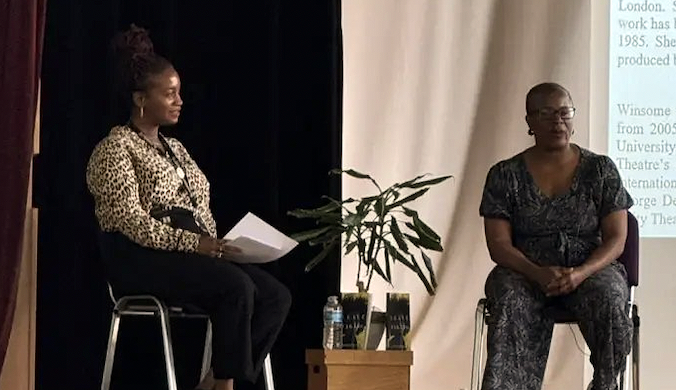
Winsome Pinnock on stage at an event at St Angela’s Ursuline School, London, in June 2024
What support is available to support those teaching and studying the play?
A range of fantastic resources is now available for Leave Taking, with more being introduced regularly.
One of these is a GCSE study guide for the play – co-written by Lynette Carr Armstrong and myself – which breaks down and analyses key aspects of the play, including the characters, structure, themes, setting and language. Combined, Lynette and I have over fifty years’ teaching experience, and hope we have created a resource that will support the learning of this text for students, and will also provide a source for teacher’s planning to teach this text in the future. Lynette and I had the privilege of consulting with Winsome during the development of the guide. Pinnock’s invaluable commentary is woven throughout, providing a rare glimpse into the playwright’s mind and enriching their understanding of her work.
Leave Taking is not just another set text – it is a vital piece of literature amplifying Black voices, sharing insights into the Black British experience. I encourage teachers, parents and young people alike to engage with these stories. They are an important part of our history and need to be heard.

This material is adapted from posts by Samantha Wharton which previously appeared on Diverse Educators.
Leave Taking: The GCSE Study Guide by Lynette Carr Armstrong and Samantha Wharton is out now. Save 20% when you get your copy from the NHB website here. A free sample of the book is available to read here.
Leave Taking is now available as a set-text option for students sitting GCSE English Literature with the exam board OCR. It has also been selected as a set text by Eduqas and AQA, for first assessment in summer 2025. It will be joined on the latter specification by the play Princess & The Hustler, by fellow Black-British playwright Chinonyerem Odimba.
 The Prompt Book