 Solo shows are increasingly prevalent as a theatrical form – but what makes them tick, and why and how do some have a particularly lasting impact on audiences?
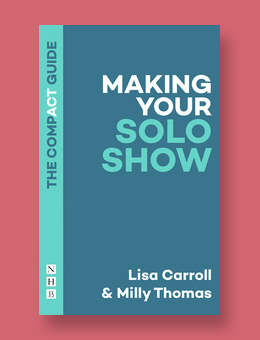
Here, in an extract from their book Making Your Solo Show: The Compact Guide, Lisa Carroll and Milly Thomas – who are both experienced writers of solo shows, and together have taught popular long-running workshops on how to write them – explore some of the common characteristics memorable solo shows share, and things to bear in mind when creating your own…
Whenever we run a workshop on solo shows, we always begin by asking everyone to share with the group a solo show they’ve seen which has really stayed with them.
The key part of the exercise is asking them to try to identify why and how the show made that impact. Words that come up all the time include: raw, honest, authentic, intimate, truthful, relatable, gritty, engaging. All definitely true – solo shows with these qualities do stand out – but these words sometimes feel quite woolly.
As writers, we need to interrogate these terms and get under the surface. What has the performer done to achieve these? Was it breaking the fourth wall to speak to you directly, in a moment you weren’t expecting? Was it using a well-chosen prop that acted as a symbol capturing the meaning of the play, and giving that prop a journey? This is the stuff you need to look out for, to add to your own toolkit.
Here are ten traits memorable solo shows tend to share, along with some standout examples of shows that include them.
1. They engage the audience
‘Engaging’ is a funny one to define, but you can see it as being held by the story and performance. Nothing is extraneous; every detail is relevant. We are in a constant state of wanting to know more, being afraid to look away or miss a word, in case we overlook some crucial detail that might pay off later.
Take a look at: Prima Facie by Suzie Miller

Jodie Comer in Prima Facie by Suzie Miller (Photo by Helen Murray)
2. They contain gripping storytelling
We need to be asking ‘What’s next?’ at all times. ‘Who is this?’ ‘Why are they doing that?’ ‘How is it going to work out for them?’ Things have to happen in your story! Things need to regularly occur that push the character to make decisions, take a course of action, and keep us guessing.
Take a look at: Far Gone by John Rwothomack
3. They test the performer
It’s true that we love to see actors sweat. That’s the beauty of live theatre – you can literally see it dripping off their face. We will care about something if you care about something. And if the performance tests you, if it feels like sharing this story costs the character (and you) something physically and emotionally, it can help us better understand its importance and value. You can test yourself in loads of ways: with the pacing, with the sentence structure, with the physicality.
Take a look at: Misterman by Enda Walsh
4. They disrupt expectations
Your audience will make assumptions about you, and what they expect your show to be, based on everything from the marketing, to similar shows about similar topics they’ve seen, to your casting and demographic. You can use this to lead your audience down the garden path with what they think your story will be about, and then pull the rug out from under them when you show them your version of the world.
Take a look at: My Son’s a Queer (But What Can You Do?) by Rob Madge
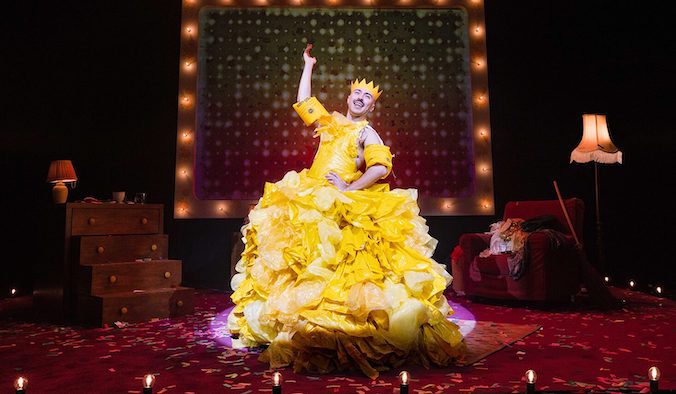
Rob Madge in their play My Son’s a Queer (But What Can You Do?) (Photo by Mark Senior)
5. They use and play with language and lyricism
There’s definitely poetry in the solo-show form. It can be a poem if you want! Either way, this is your chance to revel in the beauty and playfulness of language. To revel in how people in your world speak. Choose every juicy little word with care.
Take a look at: random by debbie tucker green
6. They have a distinctive voice
A play’s ‘voice’ is about the personality and feeling that comes off the page. It’s a combination of factors: your ‘you-ness’, how you see the world, how you commit that to paper, what story you choose, what setting, which people, the structure, whether you’re angry about the topic or hopeful, and what you leave us with by the end – be it redemption, hope, tragedy or uncertainty.
Take a look at: Fleabag by Phoebe Waller-Bridge
7. They are visually interesting
It’s just you, the words and the space. Is there a way to use the space to support the story you’re telling? Our memory for sounds actually tends to be worse than our memory for what we’ve seen… so give us something for our eyes to feast on. Visual metaphor is one of theatre’s unique and most useful tools. You can tell the story without having to put exposition in characters’ mouths, but instead with images and objects that carry meaning.
Take a look at: Misty by Arinzé Kene

Arinzé Kene in his play Misty (Photo by Sara Krulwich/The New York Times)
8. They have scale and ambition
Despite only (usually) having a cast of one, with solo shows you have permission to go big and create a vast world on stage with your storytelling. It might be the number of characters you play, or could be the set or space. It can be in the breadth of the timeline, the geography, the emotional depth, and also the themes you decide to tackle. You can take on the monarchy! You can shout from the rooftops about poverty and inequality! Being one person doesn’t mean the show can’t be big.
Take a look at: The Encounter by Simon McBurney and Complicite
9. They have a specific tone and atmosphere
Something about live theatre, being in a room with people, and the trickery of how the best solo performers can draw their audiences in, creates a kind of magic. Anything can happen in the theatre. It doesn’t have the logical and structural confines of TV. There can be ghosts. There can be sleight of hand. You can ask us to imagine you’re on top of Mount Everest. So make the most of it! You have the chance to create an atmosphere with your work that asks people to hush up, lean in, hold each other close, or burst out laughing and leave feeling joyful.
Take a look at: Age is a Feeling by Haley McGee
10. The audience will have a sense of discovery
It’s vital that you are sharing with your audience something they didn’t already know. Audiences want to discover something new about you, themselves and the world.
Take a look at: Lava by Benedict Lombe

This is an edited extract from Making Your Solo Show: The Compact Guide by Lisa Carroll and Milly Thomas, out now. Save 20% when you order your copy direct from our website here.
Lisa Carroll is a playwright, screenwriter and comedian, whose plays have been staged at Soho Theatre and the Arcola Theatre in London, and the Abbey Theatre, Dublin.
Milly Thomas is an actor and writer whose plays have been staged at Theatre503, the Edinburgh Fringe, Soho Theatre, New York Theatre Workshop and the West End’s Trafalgar Studios.
 The Prompt Book