
Tom Ryalls – a writer and leading cultural organiser, and author of This Book is Short: A Toolkit for Creative ADHDers – shares his top tips for getting a creative project started and finished.
ADHD manifests in different ways for different people, and often interacts with other aspects of our lives, our health, and the ways in which we are marginalised. For creatives, it can look like struggling to remain focused while in a meeting or performing a show, missing deadlines or auditions, getting distracted when you’re supposed to be learning your lines or working on a draft of something.
It is often said that ADHD is the inability to focus, but the most helpful metaphor I have found to describe a lot of ADHD is to think we have too much focus. We are trying to focus on all things at once, and we’re not great at prioritising those things, so we either jump between tasks or are entirely paralysed because we can’t imagine a route through doing everything at once.
After years of my own personal mystery and distraction, I applied for a grant from Arts Council England called ‘Developing Your Creative Practice’ in order to spend some time researching how to be a writer with ADHD. As part of that process I kept a diary as I began to grapple with my brain. That’s where my book This Book is Short: A Toolkit for Creative ADHDers began.
To give you a taste of my book, I’ve shared some techniques I compiled during my time researching ADHD that might also be useful to you to finish your own creative project.
TIP #1: Do a ‘shit draft’
Starting a new project, sitting down and focusing on a blank piece of paper – and trying to fill it – is hard. My brain is often trying to focus on all the possible ways that a story can go, and it’s so overwhelming that I can’t narrow it down to one I can write on a piece of paper.
So instead, I set myself a ridiculous time limit (normally something like a day), lock myself away somewhere, and attempt to write the worst version of the script possible in that time.
Your aim with your shit draft is to make it as bad as possible, because then you’re not trying to pick one good version of the project to focus on. A scene can just be a list of actions and things that need to change in order to get to the next scene. Dialogue can be really ‘on the nose’, the ending can make you cringe when you read it back – at this stage, it doesn’t matter. The point is that you’re allowing yourself to wander through your distractions and explore lots of possibilities at once.
(By the way, this principle can be applied to any creative process. I know a lot of ADHD actors who prefer to improvise their way through a script before learning lines, or designers who just stick whatever is lying around their house to a board as a first draft of a set design.)
The key components of the shit draft are:
- Intention – You have to plan to make it the worst version possible, so you don’t begin to question yourself.
- Time – The short time frame is important too, because it creates a sense of crisis that forces you to get things done and not spend too much time getting lost in detail.
- Forwards – You cannot go backwards. You must keep moving forwards, even if that means sacrificing quality or even basic sense in this draft.
From this point, you’ve done the hard part: you’ve started. Continuing from there is much easier. Instead of looking at a blank page with millions of possible options that overwhelm you, you’re looking at a lot of choices you’ve already made. The next draft, where you start crafting things, is the real draft one.
TL;DR: Set yourself a short time frame, and do the worst version of the task possible, so you’re technically redrafting from there.
TIP #2: Subtask the work
When I look at a to-do list that includes ‘Write a play’, I don’t imagine a linear, manageable trajectory – I imagine myself doing every single part of that writing simultaneously. ADHD brains are not naturally good at prioritising things, or focusing on certain things in a helpful order.
When this happens I don’t start the task, because I am so overwhelmed. I will put off starting to write for as long as possible, so that I don’t have to imagine the idea of writing a hundred scenes at once.
There is a similar feeling for actors, imagining they must learn every line of a play simultaneously, or for lighting designers imagining they have to be up forty ladders at once, focusing lights.
Instead, I now break big things down on my to-do list into micro-actions. ‘Write a play’ becomes its own list, with tasks like ‘Do the shit draft of Scene One’ or ‘Get x character out of y situation in Scene Seven’. Instead of ‘Learn your lines’, the actions become ‘Learn page one, learn page two, learn page three…’ and so on.
I call it ‘subtasking’. It means that instead of looking at a task with a huge number of possible routes, you identify tangible routes that can be completed in manageable chunks. Each time you complete one of those tiny tasks, your brain releases some fun chemicals (dopamine) that motivate you to keep going. You get lots of little doses regularly, instead of one big peak occasionally.
The balance you have to find, and there is no secret to finding this, is making sure the administration of writing the lists doesn’t take too much time away from doing the tasks!
TL;DR: Break a to-do list into small manageable tasks called subtasks.
TIP #3: Find a body double
Even if you start a task, it can take a lot of effort to keep going. Self-accountability can be difficult for creatives with ADHD as much as we want to just get things done, if nobody else knows we didn’t finish something then there are no real consequences other than our own frustration. So wherever possible, I’ve found it useful to externalise accountability by having a ‘body double’.
The three basic steps of body doubling for me are:
- Tell someone what you need to achieve (for example, a list of subtasks).
- Give them a time frame for when they should check in on you.
- Ask them to observe you in some way, whether this is in person, online, or via messaging. They don’t need to watch you all the time – being in the same room is fine.
There are lots of different ways to achieve this:
- You could create a WhatsApp group with some friends, and check in at the start of a workday about what you want to achieve and set times when you’ll check in on progress.
- You could work in a public space where people can observe you working; it’s more effective if other people know what you need to do, but not entirely necessary.
- There are online groups you can join where people sit on video-calling platforms, share their task lists, and work together while holding each other accountable.
Body doubling can be used for the non-creative tasks, too. Now, I do two structured sessions per week where I go through a list of quite boring admin tasks I hate doing, but I do them in a body-doubling session and talk about what I’m doing as I do it. This creates accountability around the less exciting elements of what I do, and it means emails don’t go unanswered for two months.
TL;DR: Don’t work alone. Set your subtasks, tell someone else what they are, and work together/on a call/in a messaging group to hold each other accountable.
TIP #4: Make a dump list / distraction box
For me the most frustrating part of distractibility is when I have good focus, and I suddenly remember that I need to change the cat’s litter, so I go and do that. While I’m getting the litter out I notice I’ve forgotten to water a plant on the windowsill, so I get the jug out of the cupboard to water the plant. And so on.
This is where I began to play with a ‘dump list’ – a place you can quickly dump the thoughts in your brain for later. it’s a way to get them outside of your head, into another container so that you can re-engage with them later.
Here are some general principles for a dump list:
- It shouldn’t require a lot of effort to input. My dump list is a note on the home page of my phone – I add something in seconds and then forget about it.
- It should be something you won’t lose. I tend to find low-value items like notebooks are easier to lose than a phone.
- It should be on something you nearly always have on you. You don’t just get random thoughts when you sit down to be creative, you get them at all points of the day and if you end up with multiple dump lists you might lose something.
- Set a rhythm for checking the list. I check mine once a day, because I know it’s rare that something needs to be done the same day. At the end of the day I either do some of the tasks if they can be done quickly (e.g. clean the cat litter), or if they’re more complex I add them to my task management software, Asana (e.g. cut the first four lines from that scene I wrote four days ago).
The important point is that there’s a system. If you know that anything that goes on the list will be checked once each day, and then added to another long-term system like task management if necessary – then you don’t actually have to remember to do any of that in the moment. There are rules that will remind you.
TL;DR: Dump your thoughts in a list, and then set a regular point where you check them and action them.
TIP #5: Finish on a high
When you’re done with your creative practice for the day, it’s important to switch off in some way in order not to burn out before the next session.
This is easier said than done. The worst days are when I finish on a task that is only half completed. I cannot break the focus I’ve worked hard to create and relax; I am constantly thinking about what needs to be done. It can become a bit like an addiction, which makes it difficult to sleep (and when I don’t rest, most of my ADHD traits get worse).
I began trying to leave myself a gift for the end of the day, something that was easily completable, and that would create some satisfaction. If you have a group of subtasks, find one that logically feels like an ending and let that be the last one of the day. The easiest one, if all else fails, is to print the section of script I have been working on, to create a thing I can hold in my hand.
I’ve spoken to actors about this, who likened it to how they found cool-downs useful at the end of a rehearsal. We focus so much on warm-ups in theatre rehearsals, and less on cool-downs because people normally have to dash to get home. But a cool-down does create a useful sense of detachment.
Finishing with a completed task (like printing out that day’s work) lets your brain break focus, and move on to your evening.
TL;DR: Always finish a day of sessions on a completed task.
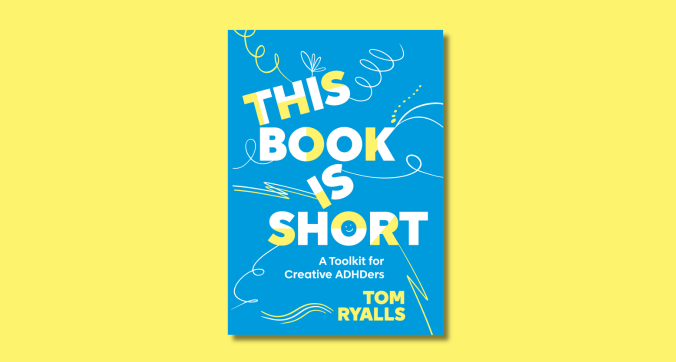
This is an edited extract from This Book is Short: A Toolkit for Creative ADHDers by Tom Ryalls – out now, published by Nick Hern Books. Save 20% when you buy your copy direct from the publisher here.
Tom Ryalls is a writer and cultural organiser, working on fundraising and strategy with disabled artists and disability arts organisations. He was named on the Disability Power 100 list in 2024 as one of the ten most influential people working in the performing arts, television and radio. As a writer, he has written work for theatres across the country including HOME in Manchester, Stratford East, the Barbican, Shoreditch Town Hall, the Royal Court Theatre, and Cast in Doncaster.
 The Prompt Book