 In her extensive work with dyslexic and neurodiverse actors, mentor and coach Deborah Groves has helped performers at all levels discover how they learn and work best, and identify strategies to help them achieve their goals.
Here, in an extract from her book The Dyslexic Actor’s Toolkit, Deborah shares her top tips for sight-reading in auditions and rehearsal.
There is something paradoxical about being dyslexic.
On the one hand, dyslexic people are amongst the most amazing, colourful, fun, humorous, intelligent, successful people in the world. Determined, unyielding, versatile, pioneering, instinctive, spontaneous, exceptional, brilliant and creative.
And yet on the other hand, many of the dyslexic creative people I work with – in my career as an acting and arts accessibility coach, and a creative enabler – have told me they experience common challenges: things like time management and organisation; processing, keeping hold of and remembering information; and struggling with a feeling that they’re not quite good enough.
The great news is that the exact strengths and qualities you may notice as a dyslexic person – being determined and driven; being empathetic and a good team player; being good at thinking out of the box and finding creative solutions to problems – are exactly what are needed to be a fine actor! There are many famous and successful dyslexic actors – people like Keanu Reeves, Salma Hayek, Keira Knightley, Whoopi Goldberg and Tom Holland.
Every dyslexic person is different. By becoming more aware of the unique ways in which you learn and work best – and the defences you put up when you feel unsafe and vulnerable – you can set yourself up to overcome obstacles, build your confidence, and unlock your full potential as an actor.
This is where my book, The Dyslexic Actor’s Toolkit, comes in. It’s full of techniques to help you better understand your dyslexic identity, develop the key skills you need as an actor, and manage your professional career. There’s also a chapter for non-dyslexic people in your life (teachers, directors, parents, and so on), with advice on how best to support you. It’s available in paperback, ebook and audiobook, so you can access the information in the way that works best for you.
To give you a taste of what’s in the book, I’ve shared some strategies to help with sight-reading below.
Sight-reading can be particularly challenging for dyslexic actors, and while it is something which can be asked of you in an audition, you or your agent should always ask for any material in advance so that you can be allowed to prepare.
You may be nervous about telling a potential employer that you are dyslexic. It’s important to remember that it is illegal for anyone to choose not to give you a job for this reason. You might not get the job for other reasons, but you should feel able to share this information about yourself comfortably so that you can ask for the support you need to do your best in auditions and rehearsals.
Here are some strategies you can use to make sight-reading easier.
1. Make use of access tools
There are certain practical things that can be done with text to make it easier to read. If you know what supports you best, you and/or your agent can ask for these things to be provided by the director or casting director.
Alternatively, there are tools which you can make or buy to help you, and you might like to take those with you into a situation where you might be asked to sight-read:
- You can ask for material to be printed in a particular font. Try some simple fonts such as Arial or Open Sans, in point sizes that aren’t too small.
- You can ask for any material you will need to sight-read to be provided on coloured paper.
- Go and buy a pack of different coloured paper, and experiment with printing things on the different colours. Is there a colour that makes text easier to read for you?
- If you are uncomfortable with asking for this in advance, you can help yourself by buying a coloured overlay – this is a see-through coloured film that you can place over white paper to make the print clearer.
- You can also purchase or make guided reading strips – these are strips of paper or card with a hole cut out so that you can only see the line you are reading, and you move the strip down the page, sentence by sentence or line by line. This will help you to focus on the bit you are reading.
If you don’t want to use any of these methods, simply use your finger as a marker. With one hand holding the script, you can use the other to mark the line you are reading with a pointed finger or a horizontal finger sliding down the page like a ruler.
2. Re-focus your attention
One of the biggest barriers to successful sight-reading for dyslexic actors is being distracted by your own panic. If you are focused on the text you cannot focus on yourself.
Turn your thinking away from yourself and onto the text. The writer wrote it for the audience – you are just the vessel of transportation. It’s not about YOU. Once you stop focusing on yourself, you’ll find connecting with the text a lot easier.
Realise that weeks of work goes into a performance. This sight-reading cannot possibly match that, and whoever you are sight-reading to knows this! If you alter your attitude and see this as an ‘offering’ to begin from, you might feel freer. Remember they aren’t looking for perfection, but for a bold, interesting choice, and potential.

Don’t worry about perfection when sight-reading – instead, try to focus on making interesting choices and showing your potential.
3. Practise
The more you practise sight-reading, the better you will get at it. Sight-reading will become more habitual and less scary, and instead of panicking when you get asked to sight-read, you’ll know what to do – you’ll have already done it loads of times!
- Practise little and often. Do a workout every day if you can – this makes for mastery.
- Try sight-reading five lines of one column in a newspaper.
- Try with an old script or a book.
- Now try an advert, or cooking instructions on food. Anything is practice!
- As you get better, try to raise your head from the text more often, so that when you are reading for an audience they get to see your eyes and not only the top of your head. Read through the first thought looking down at the text. Then raise your head and eyeline to speak the line to the other actor(s). Then look down to read the next thought, and up again to speak it, and so on. This process may feel quite slow, but don’t worry, as long as you are holding the attention of the audience with your delivery, they will wait.
4. Read actively
In most situations where you are required to sight-read you should still be given the opportunity to read over the text briefly before you ‘perform’ it. In an audition, you may have a few minutes outside the room with the text before you go in. If you are handed the text in the audition you can request this preparation time.
This strategy is about physicalising the text in your practice read-through. It will help you to absorb and understand the information in the text as you read over it. It will also focus you and force you to be active, which will make it harder for you to be distracted by panic and simply run your eyes over the text without taking any of it in.
- Read the text aloud slowly (including the stage directions and scene settings – these contain helpful clues)
- Use one or several of the strategies listed in The Dyslexic Actor’s Toolkit under the section ‘Line-absorbing’.
As you are likely to be short on time, use whichever exercises work best for you, but if you can, try a combination of several. It is like building up a wall from different layers of bricks, one layer at a time to take you to a position of knowing more than you did in the beginning.
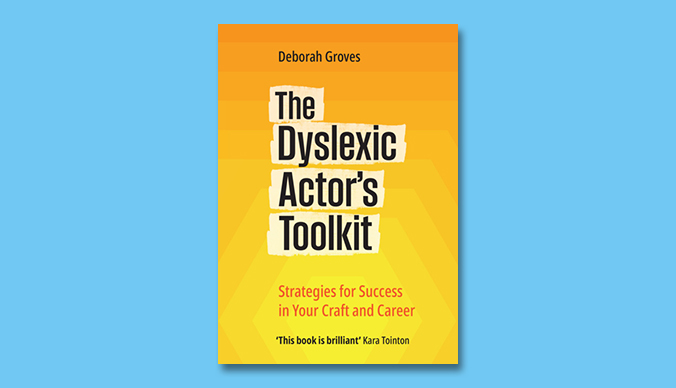
This is an edited extract from The Dyslexic Actor’s Toolkit by Deborah Groves – out now, published by Nick Hern Books. Save 20% when you buy your copy direct from the publisher here.
The Dyslexic Actor’s Toolkit is also available in audiobook format, read by Sarah Lambie. Listen to a sample and get your copy here.
Deborah Groves is an acting and arts accessibility coach, and a creative enabler, who works primarily with neurodiverse stage and screen actors, writers and dancers. She has worked with leading organisations such as the Royal Court Theatre, Shakespeare’s Globe, Almeida Theatre, Royal Shakespeare Company, Paramount Pictures and Netflix, as well as with many UK drama schools.
 The Prompt Book