 Clowning is a way of creating and performing inspired by pure play. For internationally renowned teacher, director, and actor Joe Dieffenbacher, a clown is not a character, but an energy – a way of relating to the physical world.
Here, in an extract from his book Drama Games for Clowning and Physical Comedy, he explains how tapping into that energy can help groups of all kinds be more creative, curious and collaborative. Also included are two sample games to show how this approach works in practice.
Clowning gets dressed up in different ways, has certain traditions and styles, but, at its core, it is a way of interacting with the world through play.
Most people, when they hear the word ‘play’, think of something frivolous, distracting, entertaining – neither serious nor practical. Yet real play requires thoughtful action. It can:
- create connections and foster relationships
- deepen your understanding
- expand your imagination
Play is a complex activity, both fun and serious, rigorous and ridiculous, an opportunity to succeed through skill, willpower or luck, but also fail honestly, deliberately, exuberantly, in order to expand the possibilities of your current situation.
Exploring clowning can therefore be useful for anyone trying to encourage participation and creativity, individual invention, and ensemble exploration. Over the course of my career, I’ve led clowning sessions with actors, improvisers, stand-up comedians, circus acts, musical-theatre actors, Renaissance players, cabaret artists, mask performers, Shakespearean actors, Commedia troupes, opera singers, at-risk youths and business executives.
Some participants had known each other for months, others only met that morning. I’ve worked with tight ensembles that have collaborated for years, and with groups struggling to find a way to connect. I’ve run one-day workshops, seven-week intensives and four-year graduate programmes exploring physical-theatre styles. Clowning can also help existing groups develop original work, or bring a new approach to existing, scripted plays.
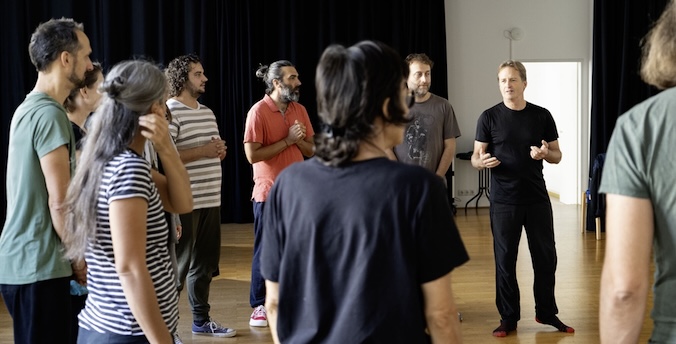
‘Clowning can be useful for anyone exploring participation, creativity, invention and exploration’ – Joe Dieffenbacher leading a workshop (photo by Red Nose International)
So those are the benefits of exploring clowning. But how do you teach something that is inherently unpredictable, which resists being defined? How can you introduce it to students, ask them to consider it thoughtfully, while it dances around them, seemingly always out of reach?
Perhaps the best way to learn about clowning is to join the dance: get up and move, relate – and, yes, play.
I usually don’t teach traditional clown routines but instead, through exercises and games, try to develop in participants the mind of a clown. To think like a clown is to see the potential for play everywhere – in every idea, movement, prop, costume, scene, and in every partner. Play becomes not an activity indulged in now-and-then, but the visible outcome of a constant state of mind. It is through lively and sometimes ferocious play that we raise the level of energy and connect with one another on a more dynamic level.
Games get participants used to playing, and then carrying this energy with them beyond the classroom (whether that’s to the stage, or just the world at large). Through these exercises, we can also focus on different areas, such as:
- building and strengthening the connections within a group
- developing physical and mental flexibility, including through improvisation
- nurturing curiosity and collaboration, but also exploring the effects of competition and complication
I’ve now collected the games I use in my training into a book, Drama Games for Clowning and Physical Comedy. It offers eighty games which have been developed, added to and refined by me over the course of many years, with students from all over the world, and many different performance styles. They come from a number of sources. Some are drawn from books on children’s games, others from actors or improvisers. Some I invented to help teach things specific to clown or devising new material.
Two of the exercises from early in the book are presented below. These are focused on building the ensemble – as the book progresses, the games expand and get bigger (in clown terms, from minimum to MAXIMUM). As this expansion happens, it can get a little crazy, at times bewildering. But I’ve always found that Players begin to delight in the hustle and bustle, wonder at the feeling of being overwhelmed by it all, and enjoy the opportunity to share this moving puzzle with others.
Slowly, they begin to see that the apparent madness in all this movement can be a method, and that play can be a pathway to learning. Because through play, we can engage physically, emotionally and mentally with everything around us. We can play not only with physical, visible worlds – but hidden and imaginary worlds as well, ones not yet created.
Sample Game One: Buf Da
This is one of the best games I know for exploring group rhythm, timing, learning to stay calm in the midst of group activity, and being able to take the lead in a game or scene.
One Leader, One Ball: The Players stand in a circle, arm’s length apart. One ‘Leader’ stands in the middle holding a ball (a volleyball, Nerf or playground ball works best – nothing too light, small or hard).
Leader and the Players toss the ball back and forth saying ‘Buf’ on the throw and ‘Da’ on the catch (the ball always goes from Leader to a Player in the circle and back again – never from Player to Player). All the Players (including Leader) time the words so they say ‘Buf’ at exactly the same moment as they throw, and ‘Da’ at exactly the same moment as they catch. This timing is crucial in later variations. Everyone works to create a rhythmic connection between sound, throw and catch.
Any Player can take over from Leader by stepping into the circle and placing a hand on Leader’s shoulder (make it a prolonged contact, not a tap). This is the signal they want to lead. The old Leader joins the circle, the new Leader takes over without stopping the game: the Players in the circle time their throws so that the new Leader can take over seamlessly.
Once the Players get the hang of it, let Leader get three to five throws, then a new Leader takes over. This keeps the exchange between Leader and the Players active and lively. Make sure everyone takes a turn at being Leader.
One Leader, Two Balls: Played as above but the Players toss two balls. Start with one ball in the hands of Leader, one in the hands of a Player in the circle. Throws are timed so that as one ball goes out to a Player, another comes back to Leader: neither Leader nor Player should ever end up with two balls. Any Player can become the new Leader as above. Say ‘Buf’ and ‘Da’ loud and clear, so that Leader knows where the balls are coming from, and all the Players know where they’re going to.
Buf Da Chaos: One Leader in the centre, two balls. The Players don’t maintain a circle but move around Leader in a random way, weaving around each other, some running, some standing still. Balls always go from Leader to the Players, never from Player to Player. This is when all elements are crucial: the words ‘Buf’ and ‘Da’ spoken loudly, timed exactly on the throw and catch, said with the intention of getting Leader’s attention. The Players must stay focused on where the balls are at all times. Any Player can become the new Leader, as above.
Objectives and suggestions:
- Leaders can control the rhythm and speed of the game. If they feel bewildered, they can slow it down and prompt the group to play at a more relaxed pace. If they feel playful, they can speed up the exchange, challenge the group with how they throw, roll, bounce or hand off the ball. This is a chance to learn to own the role of Leader.
- The Players in the circle must support each Leader’s way of playing. Some will be focused and skilled, others overwhelmed and awkward. The Players must adjust the rhythm and pace of their game according to each Leader’s ability. At the same time, they should challenge Leader with how they throw, roll, bounce or hand off the ball, always sensitive to Leader’s response. It’s a collaborative game not a competition.
- This game is effective in understanding timing, tempo and rhythm, and how to be a leader and control the play or scene by establishing pace and focus; it also shows the Players how to play with and provoke – and support – a leader, while staying aware of others in a scene
Sample Game Two: Who Started It?
This game requires individual concentration and group focus, and the ability to pay attention to many things all going on at once.
The Players sit in a circle. One is chosen to be Observer and leaves the room while the others choose a Leader. Observer returns to the centre of the circle. Leader starts a game – it can be waving a hand or raising an eyebrow. The Players copy Leader and continue the movement until she changes it.
The objective is for the Players not to reveal to Observer who Leader is, while Leader must change the game without getting caught by Observer, who must guess who’s leading. If Observer guesses wrong, he must perform: perhaps by imitating a chicken, doing three push-ups, singing a short verse from a nursery rhyme in falsetto, etc. When Observer guesses correctly, he joins the circle, a new Observer is chosen and leaves the room, the group chooses a new Leader, and the game starts again.
Objectives and suggestions
- The Players work together to develop a variety of tactics for hiding Leader. How do they use these tactics to fool and misdirect Observer?
- The Players should try looking at the group rather than Leader to see when the game changes.
- As Observer, what are the tactics for finding Leader?
This is an edited extract from Drama Games for Clowning and Physical Comedy by Joe Dieffenbacher – out now, published by Nick Hern Books. Get your copy at a 20% discount here.
Joe Dieffenbacher is a teacher, director, designer, author and actor known for his theatre, circus and cabaret performances under the name nakupelle.
He has worked in various roles in productions at venues such as Shakespeare’s Globe, London, Regent’s Park Open Air Theatre and RADA, and with companies including the Scottish National Opera, Coastal Carolina University, and the Dell’Arte Players, California. He was director of Clown Conservatory at the Circus Center, San Francisco, has served as lead instructor as Dell’Arte International, and has been a guest teacher at the Belfast Community Circus, Teater Studion in Stockholm, Wuqiao International Circus Festival, Shijiazhuang, China, and the American Conservatory Theater in San Francisco.
As a clown and physical comedian, Joe has collaborated on six productions with British pop sensations Take That, co-created sequences for the Closing Ceremonies of the London 2012 Olympics and Paralympics, was a clown and elephant jumper with the Ringling Bros. and Barnum & Bailey Circus, and collaborated on shows for Disney in California and Florida. His own company, nakupelle, has been featured in theatre seasons, outdoor festivals, circuses and cabarets in Europe, Asia and North America.
 The Prompt Book