 Linden Walcott-Burton has over fifteen years’ experience of running drama workshops – including for the National Theatre, The Old Vic, Barbican, Battersea Arts Centre and National Youth Theatre. Now he’s written The Drama Workshop Leader, a comprehensive, easy-to-use guide that contains everything you need to plan and deliver effective drama sessions yourself. To get you started, here are his top tips for success…
One of the reasons I wrote The Drama Workshop Leader is because I couldn’t find anything like it in print. I’ve spent years running workshops in just about every environment you can imagine, and I wanted to capture all the ingredients that make a great workshop and an effective workshop leader.
It’d be impossible for me to distil the entire book for you here. So instead, here are five of my favourite tips, along with a bonus exercise.
1. Consider the physical transitions between your exercises
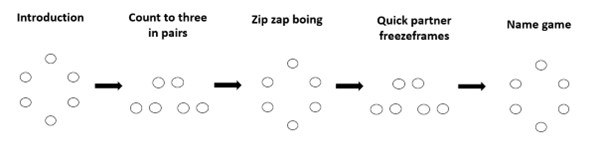
Getting an exercise to end in the formation that the next one starts in will mean your group won’t need to physically rearrange themselves. You can go straight into the next exercise with no fuss. Obviously, there’ll be times where you have no choice, but reducing the amount of rearranging people need to do will speed up your workshop, make it more efficient, and keep the group’s attention.
A workshop with bad exercise transitions:
A workshop with good exercise transitions:
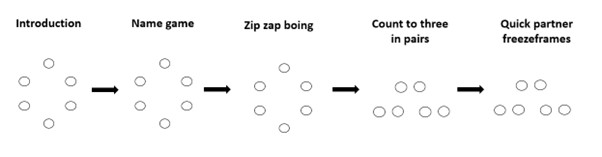
This is especially important if you’re working with groups that are challenging, because the more you ask people to rearrange themselves, the harder it’ll be to keep them focused. A disciplined group can rearrange themselves in ten seconds, but a group of distracted teenagers? About ten minutes.
This also ties in with behaviour management, because a group’s physical arrangement can have a huge impact on their attention. There’s a whole chapter in the book dedicated to behaviour management.
2. Break your exercises down into stages
This is one of the most powerful techniques in your toolbox as a workshop leader, because it gives you immense control and adaptability in how you deliver your exercises. By breaking your exercises down into stages, you can control the group’s progression from one stage to the next, allowing them to move on to the exercise’s next stage once they’ve completed the stage they’re on.
For example, if you were playing the game ‘Zip-Zap-Boing’*, you’d teach the Zip first; then once the group is comfortable with that, you’d teach the Zap; and after that, the Boing. Then you’d put it all together. This is much more effective than trying to explain all three elements at the start, and asking the group to do them all straight away.
There are some additional benefits too. One is that it allows you to tailor your exercises to different ability groups. It’ll stop advanced groups from becoming bored if they finish early because you can give them the next stage of the exercise, while slower groups can be given more time and won’t have the feeling of getting left behind. You won’t be able to do this for every exercise, but it should be your approach for most.
*Zip Zap Boing:
Zip: Sends the energy to the next person in the circle
Zap: Sends the energy to someone across the circle
Boing: Deflects a zip back to the person who sent it
3. Adapt your exercises to suit the circumstances
Being able to adapt your exercises is one of the keys to delivering an effective workshop. There are two main ways to do this.
For games/warmup activities:
You can change a game or exercise to suit the theme of your workshop. For example, Zip-Zap-Boing is a fairly neutral game, but you can adapt its style as you please. In a Shakespeare workshop, the ‘Zip’ could become ‘to be…!’, the ‘Zap’ could become ‘thou villain!’, and the ‘Boing’ could become ‘or not to be!’. Or if you wanted to have, say, a Star Wars theme, you could replace the actions with lightsaber sounds or appropriate quotes, such as ‘I’m your father!’ for the ‘Zap’. Have fun with it!
You can even take this a step further. For example, there’s a game used by Tender, an organisation that uses drama to teach healthy relationships. In this game, one player tries to get up from the chair they’re sitting in, while their partner stands behind them and can tap them on the shoulder to stop them from moving to another chair. Played normally, it’s simply a fun, competitive game. But Tender use it to highlight how difficult it can be sometimes to leave unhealthy relationships.
There are lots of drama games and exercises out there. The key is to adapt them to support the aim of your workshop.
For people with special needs or disabilities:
There’s a chapter in the book on working with disabled people, with a key section on how to adapt exercises for people with special needs and disabilities. Sometimes these adaptations will be relatively straightforward, while at other times they’ll require more creative thinking.
For example, if you have a wheelchair user in your group, a ‘clap/jump’ instruction in a call-and-response game could be tweaked to ‘clap/touch your knees’. This would be an easy tweak to make, and would allow that person to participate without any huge changes to your content.
However, not all exercises can be adapted. I give an example in the book of a movement game that has people jumping on the spot and turning around on a single count. Because that’s the core component of the game, you wouldn’t be able to adapt it for a wheelchair user without it becoming an entirely different exercise. So what you’d need to do is to find a different exercise that’s accessible, but achieves the same or a similar outcome – in this case, something else that’s physical, uses rhythm, and is a group exercise. That way the group will still achieve the objective, just with a different exercise.
4. Get people into groups effectively
Of the four techniques I give in the book for putting people into groups, by far the most popular is giving people group numbers. This is where you give each person a number between one and (as an example) four, then you set them off to their relevant numbered corners of the room.
However, this can very easily get confusing. If you’re working in a school, for instance, this technique can cause absolute carnage.
‘What number am I again?’
‘I’m not a one, I’m a four!’
‘There are four groups? But, miss, I’m a six!’
‘Sir! We’ve got two in our group and they’ve got seven!’
Hell on earth.
I’ve seen this happen to even the most experienced facilitators. To solve this, put people into their groups in real-time. For instance, if you’re doing four groups, give each corner of the room a number up to four, then give each person in the circle a number and send them off to their corner straight away. Don’t give out the next person’s number until you see the current one walking. It’s such a simple tweak, but it’s an absolute game-changer.
5. Ask answers, don’t give facts
You can give your group a bunch of facts, but that means they’re not using their brains. What you can do instead is use inference. Rather than simply giving them the facts, ask them questions which prompt them to make educated guesses about the answer. Here’s an example:
| To give the facts | To have them infer |
| You: A dog is a domesticated wolf. It usually takes thousands of years to domesticate an animal. | You: What wild animal do you think dogs came from?Them: Huskies.You: Huskies? You’re close. But do huskies live in the wild? What animal can you think of that’s similar to a dog that lives in the wild?Them: A wolf.
You: A wolf, absolutely. So how long do you think it’d take to tame wolves? Could you do it in a day? Them: No. It’d take a long time. You: Exactly. It’d actually take thousands of years. |
To have your group infer the answers is to give them the facts at the end, not at the start. It’ll also help to involve those who aren’t actively speaking, because even though they might not be contributing verbally, they’ll still be thinking of the answers to your questions in their heads. And, to actively engage the quieter people in the room, you can always use techniques such as ‘pre-loading’. There is more about this – and lots more besides – in the book.
Lastly, here’s a bonus exercise you might like to try…
Bonus Exercise: The 10-Minute Slot
This has to be my favourite workshop activity of all time, and it’s one that I always use on my National Youth Theatre intensive courses.
The 10-Minute Slot is an exercise that allows people to share who they are and things about their lives with the rest of the group. It’s not often that we get to open up about ourselves or are truly listened to in life, so this can be a brilliant way for your group to get to know each other and to build a strong sense of trust.
The way I do it is this: at the end of each day, I have three members of the group get up and talk about themselves and their lives for ten minutes, completely uninterrupted. And that’s it. It’s a really simple premise – the key to it is in how it’s established.
I set the activity up beforehand by giving each person in the group a sheet of A3 paper. After putting on some music, I get them to write down some things about their life: who they are, their passions, interests etc. I then collect everyone’s piece of paper, and put them all aside in a safe place. Then, at the end of each day, we form an audience. I pick one of the pieces of paper at random (doing a total of three per day), and with a whoop and a cheer from the room, I hand it back to the person who wrote it and they take a seat in front of us all. They then have ten minutes to talk about their life or anything they choose, uninterrupted. And we listen.
This exercise always sounds daunting when I first introduce it, but without fail it becomes the group’s favourite and most cherished aspect of my National Youth Theatre courses. As simple as the exercise is, there’s a lot you need to do to get it right. But to find out what… you’ll have to buy the book 😉
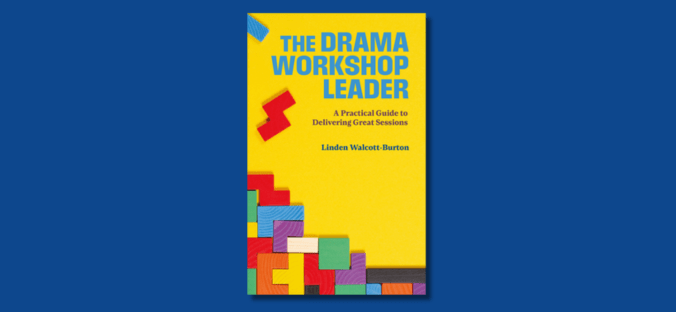
The Drama Workshop Leader: A Practical Guide to Delivering Great Sessions by Linden Walcott-Burton is out now. Save 20% when you order your copy directly from our website here.
Author photo by Ori Jones
 The Prompt Book